In short
- Device: M5Stack Core2
- Processor: ESP32
- Backend: Node.js + Gemini
Challenge
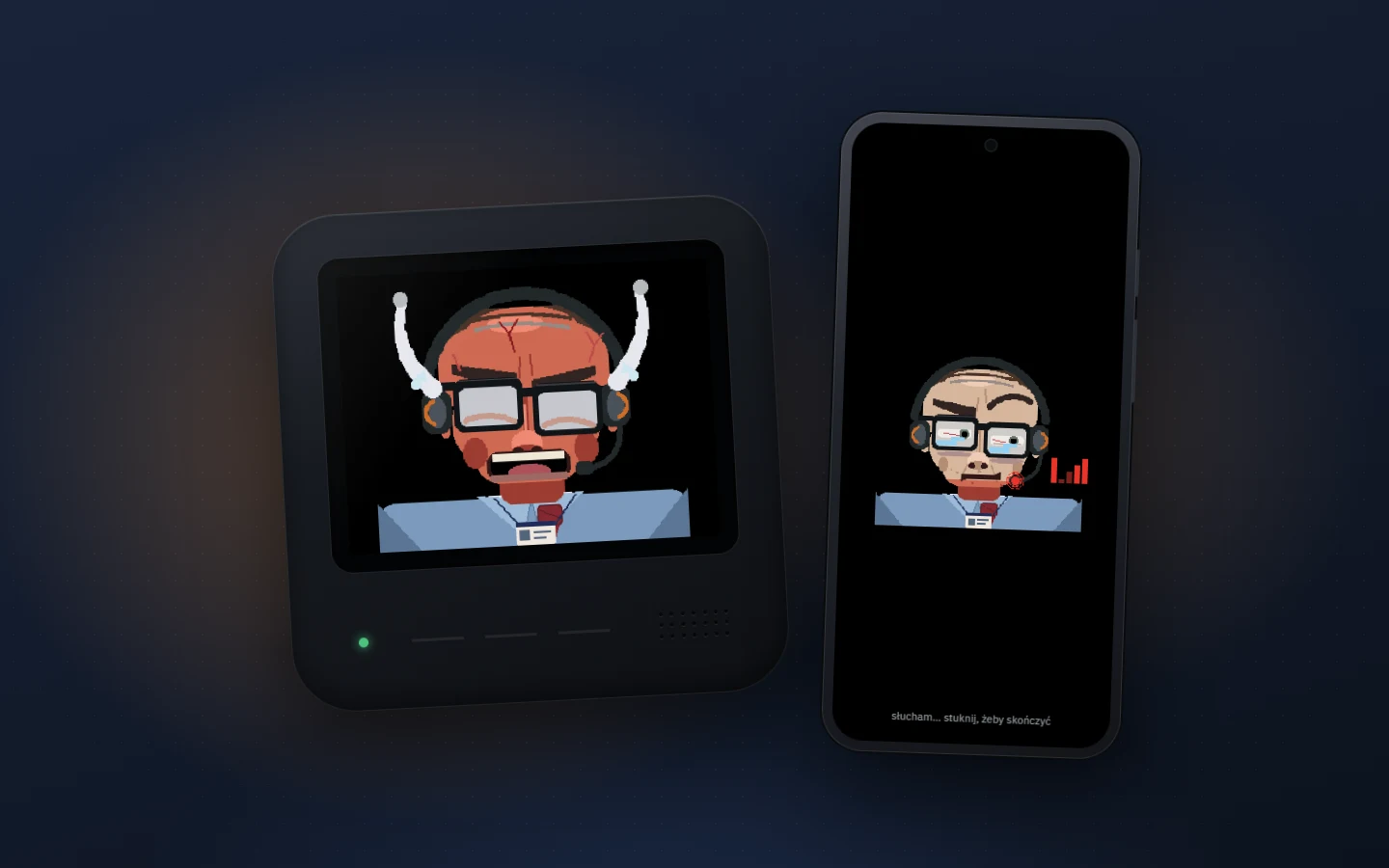
The character had to be unbearable and useful at once, and those two pull in opposite directions. A joke stops being funny the second it gets in the way of solving the problem. The heavy pipeline (speech recognition, answer generation, speech synthesis) had no chance of fitting on an ESP32, and API keys flashed into the firmware would belong to anyone who picks up the device. Then the screen: 320×240 pixels with no anti-aliasing, where emotions have to be readable from across the room.
Solution
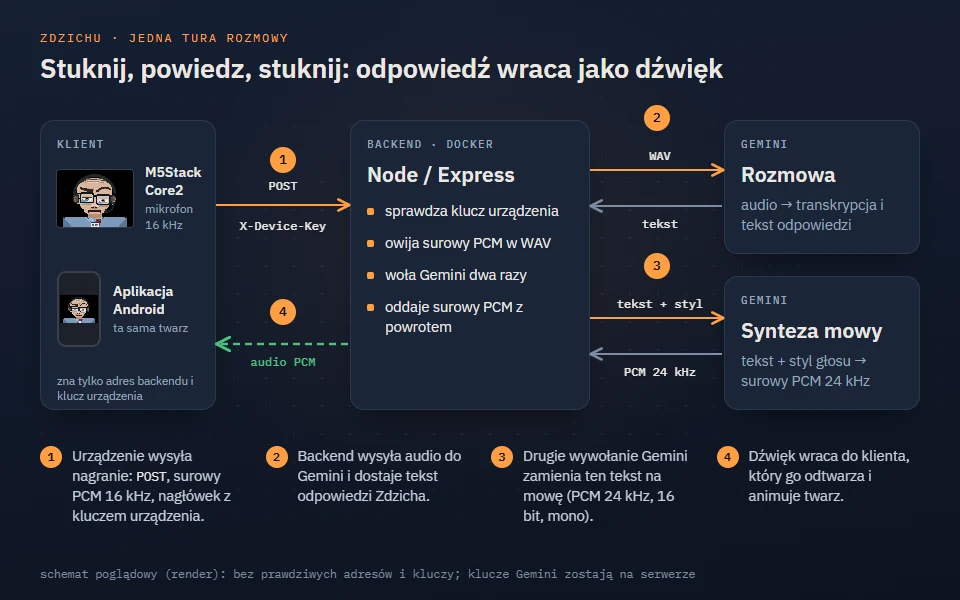
The device is a thin client. It knows the backend address and one shared secret, and no API keys. One conversation turn is one request: raw PCM goes by POST to the backend in Docker on my VPS, where Gemini transcribes and answers in a single pass, speech synthesis runs separately, and finished audio comes back. I treated emotions as a pressure gauge, not a facial expression: five face states, in which a flush of rage climbs up from the collar during a single answer and ends in an explosion. Under all the venom, the system prompt makes sure a working answer remains, because that's Zdzichu's only professional duty. The backend remembers the latest exchanges for 20 minutes, so you can ask follow-up questions.
Process
- Face as a state machine: five states drawn with the same set of pixel primitives directly on the 320×240 screen, with no anti-aliasing and no bitmaps.
- Voice control: tap-to-talk on the touch-screen face, 16 kHz / 16-bit mono recording (up to 10 s), and a second tap ends the recording and sends it.
- Node.js (Express) backend in Docker: one request per turn, the device secret in a header, raw PCM in the body; short conversation memory in the container's RAM.
- Model layer: Gemini returns the transcription and the answer in a single pass (output as JSON), then speech synthesis separately, and the system prompt keeps the line between venom and substance.
- Android port: the same face coordinates as in the firmware and the same protocol, so the app and the device talk to the same backend.
- Wi-Fi setup in the field: a device with no known network opens its own hotspot with a configuration portal, and the network can be reset by holding the screen at startup.
- Deployment: GitHub Actions builds and publishes the backend image on every push, and the stack on my own VPS, behind Nginx Proxy Manager, runs it.
What it looks like
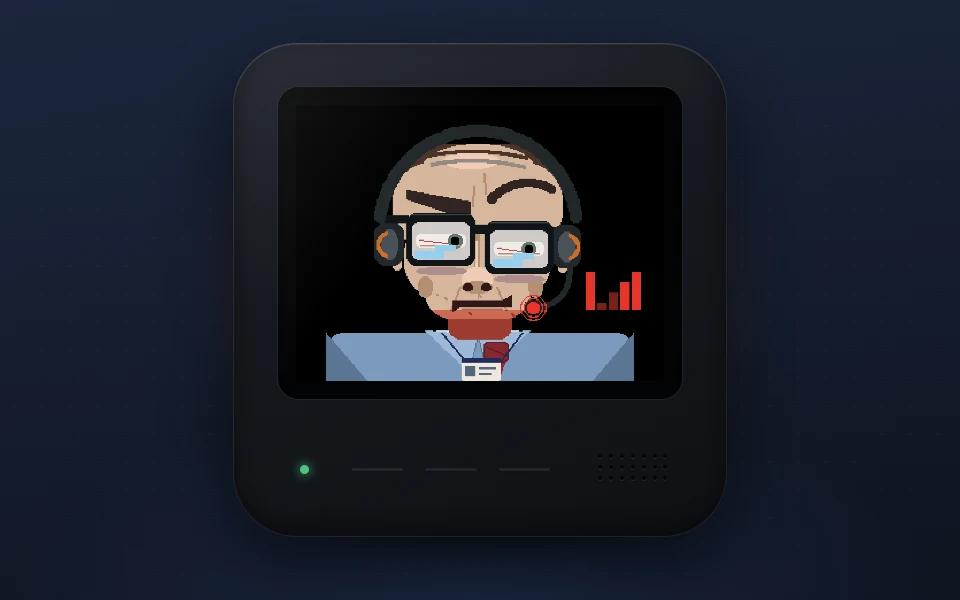
All images below are renders made from the face code, plus mockups. None is a photo of the device or a screenshot from a phone.





What it can do
- Tap-to-talk. You tap the face, speak, tap again. No button, no wake word and no listening in the background.
- A face like a pressure gauge. Five states: calm, listening, thinking, speaking and escalation. During a single answer, a flush of rage climbs up from the collar, and at the end the lid blows.
- Zero keys on the hardware. The device knows only the backend address and one shared secret. Only the backend knows the model keys, so opening the case gets you nothing.
- One turn, one request. The raw PCM recording goes in a single POST and finished audio comes back, with no session to maintain on the device side.
- Conversation memory. The backend remembers the latest turns for 20 minutes (as text, in the container's memory), so Zdzichu remembers what he just insulted you with. After a restart, he starts from scratch.
- The same face on Android. The app is a 1:1 port of the firmware's coordinates and talks to the same backend over the same protocol. It uses no external libraries.
- Voice, not subtitles. The answer comes back as speech (Gemini synthesis, the “Charon” voice) and plays once all of it has reached the device.
- Sarcasm with a limit. Zdzichu swears like a sailor at the system and the world, but toward the user he keeps to icy, precise sarcasm with no profanity, a deliberate line written into the prompt.
- Wi-Fi without reflashing. A new network is set up from a phone through the device's own hotspot, without touching the code.
- Own infrastructure. The whole pipeline runs in Docker on my VPS, and the image builds itself on every push.
Technical details
- Device: M5Stack Core2 (ESP32, 320×240 screen)
- Firmware: C++ / M5Unified (PlatformIO, Arduino)
- App: Android 8+ (Kotlin, no external libraries)
- Backend: Node.js (Express) in Docker, own VPS
- Model: Gemini: transcription, answer and speech synthesis (preview models)
- Audio: 16 kHz / 16-bit mono recording, 24 kHz playback
- Deployment: GitHub Actions (image), Portainer, Nginx Proxy Manager
Privacy
The device doesn't know any model key; it has only the backend address and one shared secret in the request header, so access to the hardware doesn't give access to the API. The recording itself is processed in transit: it goes to my backend, and from there to Gemini for transcription, the answer and voice synthesis. Nothing is recorded in the background: the microphone starts only after you tap the face and stops after the second tap.