
In short
- Stack: Next.js 16
- CMS: Payload 3
- 3D model: React Three Fiber
Challenge
I wanted to see whether I could build a shop that looks and works as if it were made for a premium brand. It's a demo, with no client and no photo catalog. The Hero needed an interactive element that says precision from the first second and still runs on weaker hardware. The order path (accounts, cart, orders, stock levels) had to work, and so did a knowledge section that can be edited without a developer. Online payments, shipping and transactional emails stayed out of the demo's scope.
Solution
Next.js 16 (App Router) with Payload CMS 3 as a headless backend in the same process: one app, one deployment, no separate CMS server. In the Hero, an interactive 3D model of a riflescope (React Three Fiber) breaks apart into its components and rotates on its own; if WebGL is missing or the frame rate drops below a threshold, a static version is shown instead. Prices and availability are calculated by the server, and pricing data from the browser is ignored. Everything runs in Docker (multi-stage, non-root user), with CI on GitHub Actions and deployment via Portainer behind Nginx Proxy Manager.
Process
- Architecture: Next.js 16 (App Router) with Payload CMS 3 as a headless backend in the same process, one app, one deployment.
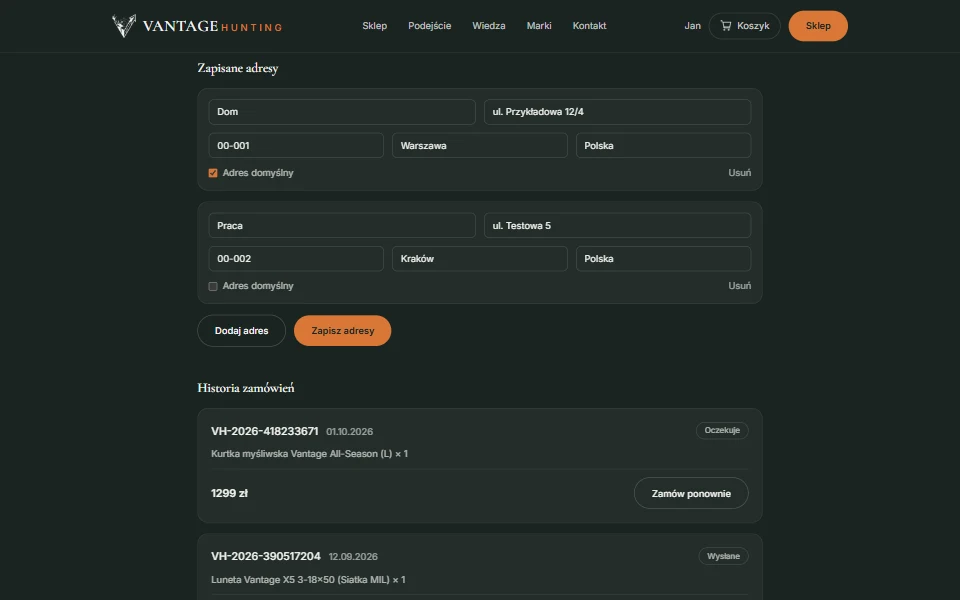
- Product catalog, cart and guest orders, plus customer accounts (order history, saved addresses). Each order gets a number and one of seven statuses; there's no online payment.
- Visual layer: a 3D riflescope model in React Three Fiber in the Hero, an animated 2D canvas background that reacts to the cursor, and a micro-tilt on category tiles, all respecting the “reduce motion” setting.
- Containerization (Docker, multi-stage build) and CI on GitHub Actions (lint, build, image); deployment via Portainer behind Nginx Proxy Manager. Database migrations run automatically when the container starts.
- Reviewing my own code while building the customer panel: I found and fixed a leak where a logged-in customer could read other customers' data and their orders.
- Optimization after a Lighthouse measurement: the 3D layer was the main source of main-thread blocking, so it loads lazily, after the load event and once the browser is idle, with a lighter render. Layout checked from 320 px up.
What it looks like
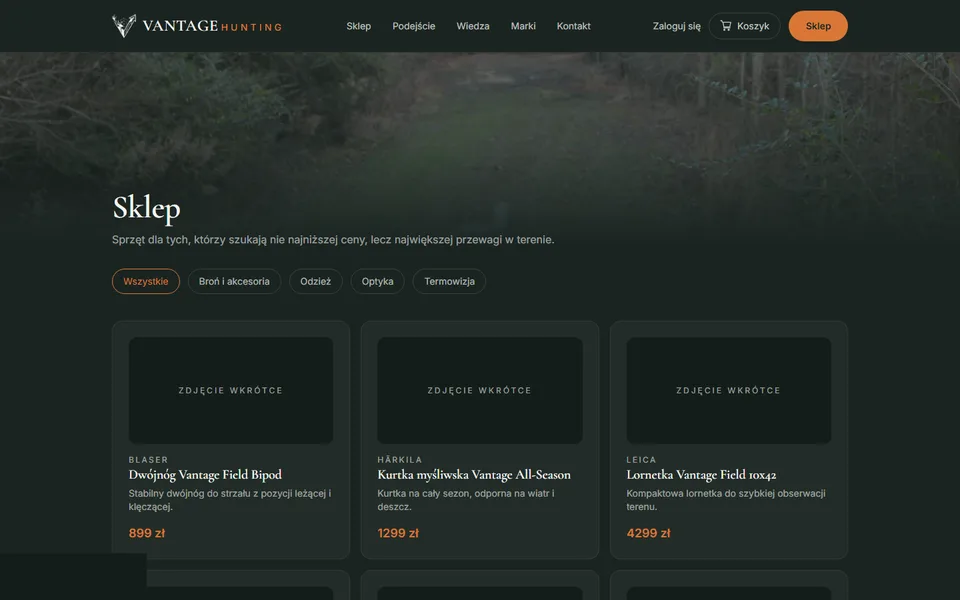
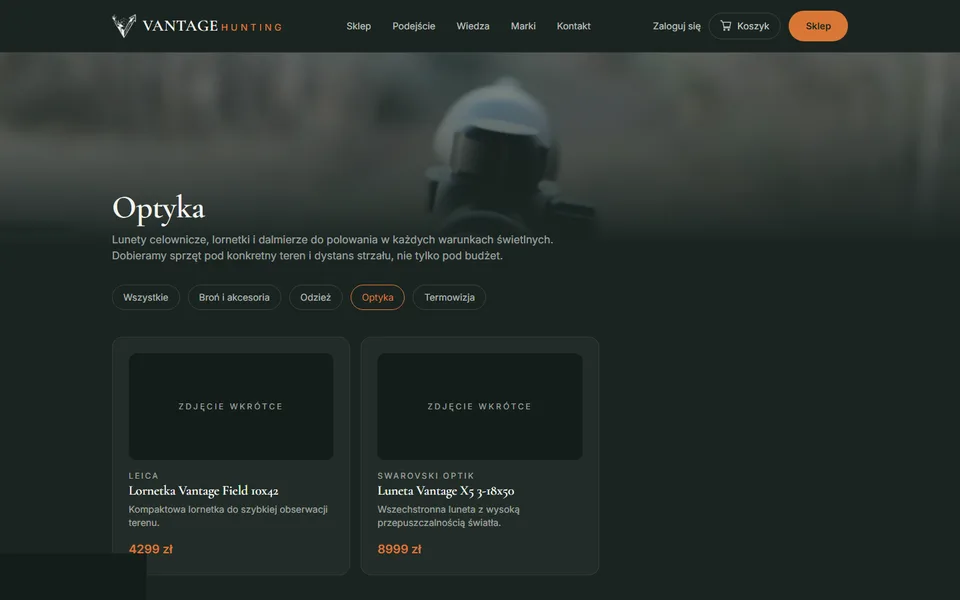
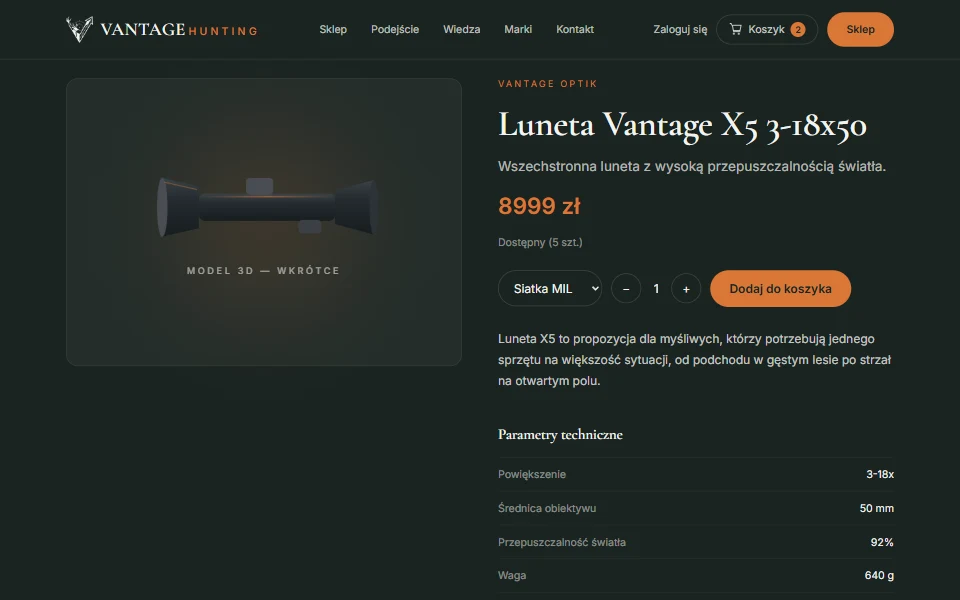
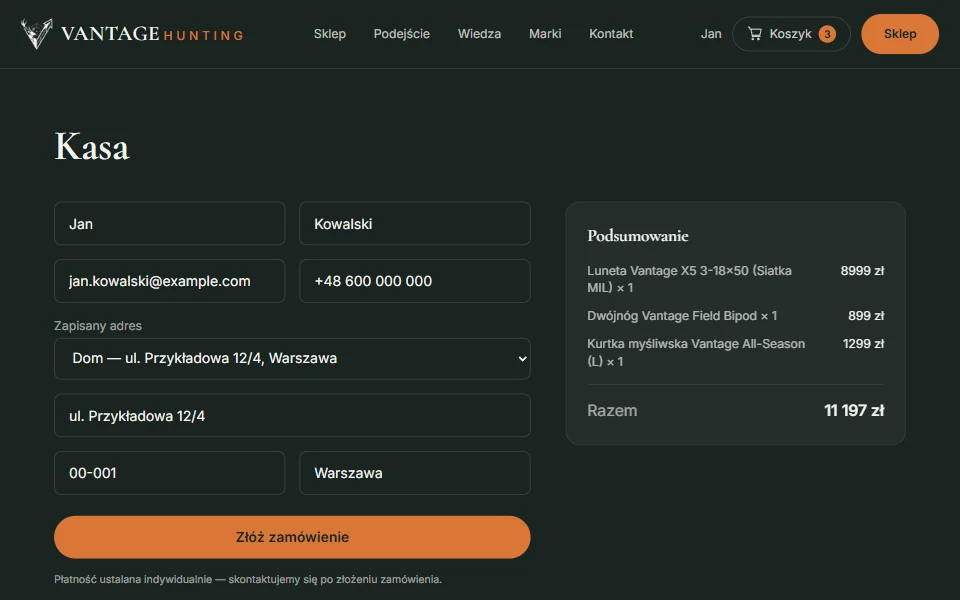
The first five images are screenshots from the live demo; the last three are mockups with sample data (made-up products and customer).



What it can do
- Interactive 3D model. The riflescope in the Hero (React Three Fiber) breaks apart into its components and rotates on its own. Without WebGL or on weak hardware, a static version replaces it.
- Catalog and stock levels. Products with categories, variants and technical specs. Availability is checked in the browser, and again on the server when the order is placed, where the server has the last word.
- Cart, orders and accounts. Guest orders and customer accounts: registration, login, order history, saved addresses, “order again”. Prices are calculated by the server. No online payment.
- Knowledge section from the CMS. A technical blog managed from the Payload panel: categories, articles and images are added without touching code.
- Marketing sections from the CMS. Hero, “Manifesto” and “The Vantage Edge” are edited in the admin panel, with nothing hard-coded into the page.
- Contact form and newsletter. Messages and sign-ups go to the CMS, with a handling status. No emails are sent.
- SEO from the CMS. A sitemap generated from the catalog, articles and categories, Product and Offer structured data on product pages, Open Graph tags.
- Cursor-reactive background. An animated “digital topography” in the background (2D canvas) reacts to cursor movement. It deliberately avoids WebGL: a second heavy 3D scene would cost too much performance.
Technical details
- Stack: Next.js 16 (App Router, TypeScript), React 19
- CMS: Payload CMS 3 (headless, in the same process)
- Database: PostgreSQL 16, migrations on startup
- Styling: Tailwind CSS v4
- Infrastructure: Docker (multi-stage, standalone), Portainer, Nginx Proxy Manager
- CI: GitHub Actions: lint, build and Docker image
- Demo scope: no online payments, transactional emails or automated tests
Privacy
While building the customer panel, I found and fixed a data leak: an API bug let a logged-in customer read other customers' data and their orders. This is a demo, so there are no real customers or payments in it, and the products in the catalog are fictional.